MUD Tax in Atascocita and Humble: Neighborhood Rates and PID vs MUD
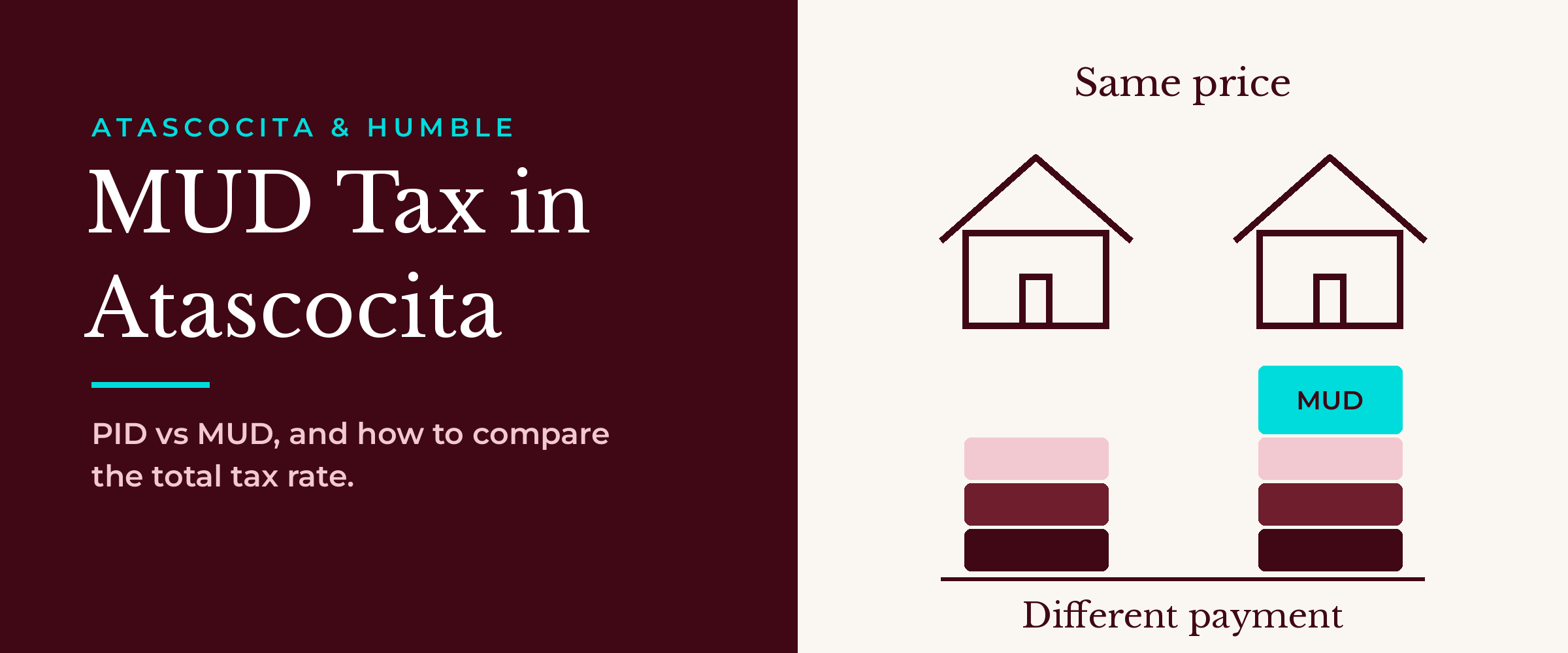
You've narrowed it down to two homes in Atascocita. Same price, similar size, both an easy drive from everything you need. Then the estimated payments come back, and one is higher than the other. What happened?
A lot of the time, it's the MUD tax. In Atascocita and Humble, it's one of the biggest reasons two homes at the same price can come with very different monthly payments. Understanding the MUD tax in Atascocita, and how a PID fits in, really comes down to one habit: comparing the total tax rate for each address before you fall in love with a house.
Charles and I pull those numbers for every home our buyers are serious about. Here's how we do it, so you can do it too.
What Is a MUD in Atascocita and Humble?
A MUD, or municipal utility district, is a small local government. It pays for things like water, sewer and drainage in areas that grew up outside city services, and it pays for them with a property tax.
You'll see that tax spelled out in the seller's MUD notice. Under Texas law, the notice states the district's rate "on each $100 of assessed valuation." It also lists the bonds voters approved and the bonds the district has issued, broken out by water, sewer and drainage, roads, and parks and recreation. And it tells buyers that the district sets its tax rate every year, so the information can change.
New to MUDs? Charles and I share how one caught us off guard on our very first home in What Is a MUD Tax in Houston?
PID vs MUD: What's the Difference?
A PID, or public improvement district, works differently. The Texas Property Code describes a PID payment as an assessment for your share of a public improvement or services project that benefits the property.
The required PID notice explains how that plays out. You can pay the assessment in full at any time. If you don't, it's due in annual installments that can vary from year to year. The exact amount comes from the city or county. And not paying can lead to penalties, interest and a lien on the property.
So here's the short version of PID vs MUD: a MUD is a tax rate applied to your home's value each year, while a PID is an assessment tied to the property. Some neighborhoods have one, some have both and some have neither.
How MUD Taxes Show Up on Your Tax Bill
Your property tax bill isn't really one tax. It's several. HCAD lists municipal utility districts right alongside counties, cities, school districts, community colleges, hospital and flood control districts as the kinds of taxing units that property tax supports, and each one sets its own rate.
Look up a home on HCAD and the account shows every taxing unit for that property. For each one, you'll see its name and code, its homestead, over-65 and disabled exemption amounts where it offers them, its tax rate per $100 of value for recent years, and who collects the tax.
Don't skip that last column. If the account lists more than one collector, you may get more than one tax bill.
How to Find the Total Tax Rate for Any Address
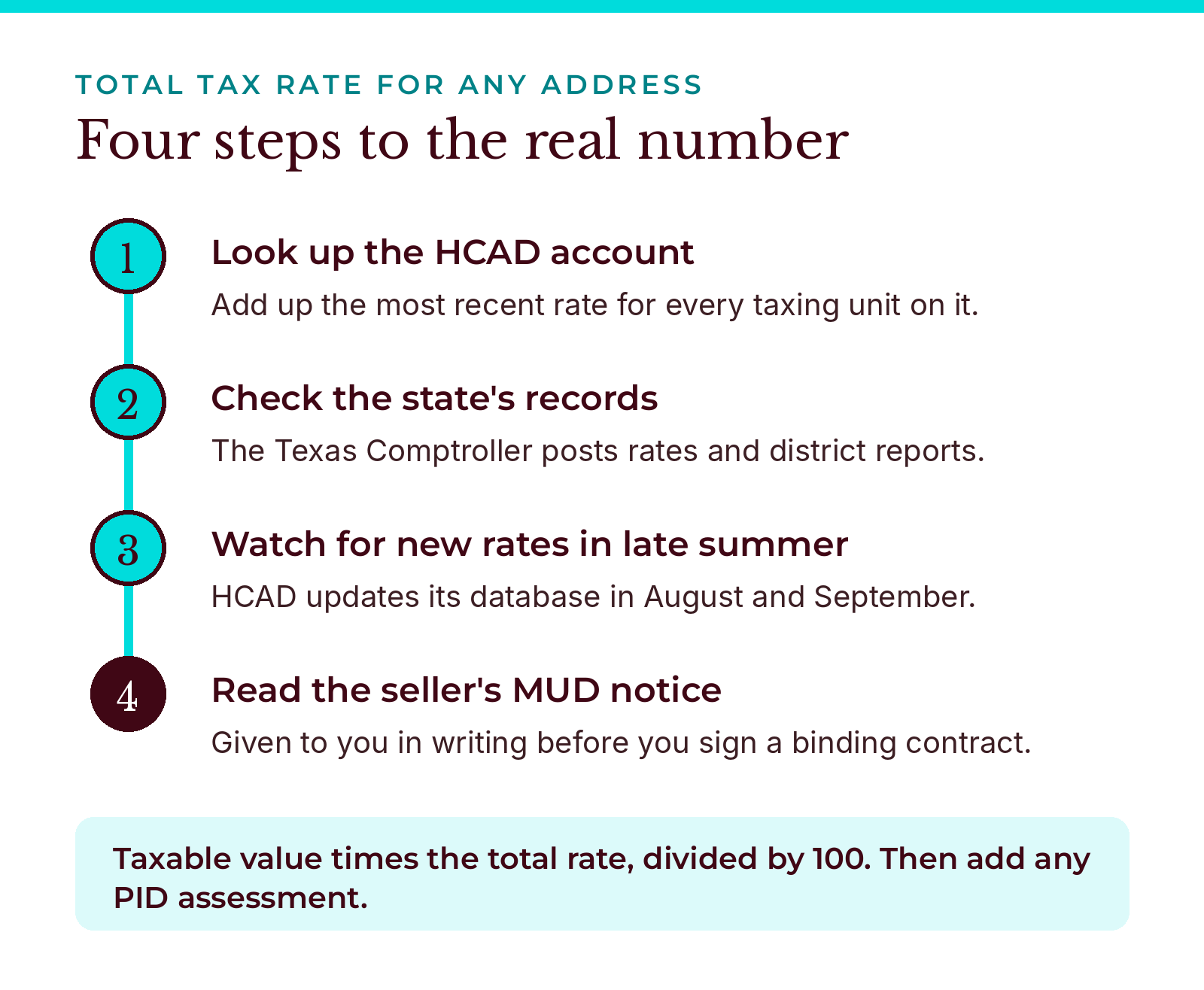
This is the part we wish every buyer knew. You don't have to guess, and you don't have to rely on a listing's estimate. Four steps get you there.
Step one: look up the HCAD account
Search the address on hcad.org and open the jurisdiction list. Add up the most recent rate for every taxing unit on that account. That total is the rate you're really buying.
Step two: check the state's records
The Texas Comptroller posts property tax rates reported by appraisal districts, including a separate file for special districts. As of November 2026, the latest year posted there is 2025. The Comptroller's Special Purpose District Public Information Database also lets you look up a district's own reports, including its tax rate per $100, whether it has outstanding bonds and who its tax collector is.
Step three: watch for new rates in late summer
Rates are proposed and adopted every year. HCAD notes that the Property Tax Database is updated during August and September, and it shows how much each taxing unit would charge if it adopts its proposed rate. Buying in the fall? Check it.
Step four: read the seller's MUD notice
Texas Water Code Section 49.452 requires the seller of a home in a district to give the buyer a written notice before the buyer signs a binding contract. TREC's Notice to Purchaser of Special Taxing or Assessment District is one form that meets this requirement, though a district can publish its own. A copy with current information is also signed at closing and recorded. If a PID applies, there's a separate PID notice under the Texas Property Code.
Take your time with these. They're some of the most useful pages in your whole contract packet.
How to Compare Neighborhoods by Total Tax Rate
Once you have the total rate for each home, the comparison is simple. A few habits keep it honest:
Use the same math for every house. Multiply the taxable value by the total rate, then divide by 100.
Add any PID assessment. It won't be in the tax rate, so add it on its own.
Look at the bonds. If a MUD notice shows voters approved more bonds than the district has issued so far, ask how that could affect future rates.
Check every address, not just the neighborhood. Don't assume two subdivisions a few minutes apart share the same districts. Even within a master-planned area, confirm the account for the exact home.
Remember exemptions differ by unit. Your homestead exemption is a big help on school taxes, but each taxing unit sets its own exemptions, and the HCAD list shows which ones each unit gives.
When we help buyers compare homes in neighborhoods like The Groves, Eagle Springs, Balmoral, Fall Creek or Summerwood, we lay each home's full tax picture side by side, along with HOA dues and an insurance quote. That's usually when the earlier question answers itself, because the cheaper price isn't always the cheaper payment.
For the rest of that monthly picture, from insurance to HOA dues, see Hidden Costs of Owning a Home in Houston.
MUD Tax Rates in Atascocita and Humble Neighborhoods
Here's what some of the neighborhoods our buyers ask about most were paying for the MUD alone. To make them easy to compare, the yearly cost is figured on a $325,000 taxable value, before any exemptions. The year shown is the latest rate we could confirm from the district or its tax collector, and every district sets a new rate each year.
Eagle Springs (Atascocita). Eagle Springs is split between two districts.
Sections 17 through 50, Harris County MUD 290: $0.69 per $100 (2026), about $2,243 a year
The earlier sections, Harris County MUD 106: $0.74 per $100 (2025), about $2,405 a year
The Groves (Atascocita).
Harris County MUD 504: $1.07 per $100 (2026), about $3,478 a year. That rate includes a road tax, because this district also paid for the roads.
Fall Creek (Humble). Fall Creek is split by Fall Creek View.
Most homes west of Fall Creek View, Harris County WCID 96: $0.63 per $100 (2026), about $2,048 a year
Most homes east of Fall Creek View, Harris County MUD 49: $0.83 per $100 (2026), about $2,698 a year
Balmoral (Humble). Balmoral shows exactly why you check the address, not just the neighborhood.
Older sections, Harris County MUD 400: $0.55 per $100 (2025), about $1,788 a year
Newer sections, Harris County MUD 423: $1.29 per $100 (2024, the latest official figure we could confirm), about $4,193 a year
That's a difference of more than $2,400 a year inside the same community.
Canyon Gate at Park Lakes (Humble).
Harris County MUD 400: $0.55 per $100 (2025), about $1,788 a year
Summerwood (Northeast Houston). Summerwood is served by more than one district.
Harris County MUD 344: $0.575 per $100 (2026), about $1,869 a year
Harris County MUD 361: $0.64 per $100 (2025), about $2,080 a year. The district proposed $0.62 for 2026.
Remember, this is only the MUD line. Your total rate also includes Harris County, the school district, the college district, the emergency services district and others. Many MUDs also give a homestead or over-65 exemption, which lowers what you actually pay. That's why we still pull the HCAD account for the exact home before you make an offer.
MUD Tax Atascocita FAQ
Which Atascocita neighborhoods have the lowest tax rate?
For the MUD line alone, the older sections of Balmoral and Canyon Gate at Park Lakes had the lowest rate we found among the neighborhoods above, at $0.55 per $100. The Groves and the newer sections of Balmoral were the highest, at over $1.00 per $100. Your total rate also depends on every other taxing unit on the account, so compare the HCAD totals for the exact homes you're considering.
Does every home in Atascocita or Humble have a MUD tax?
Not necessarily. It depends on which districts cover that specific property, so check the HCAD account and the seller's notice.
What is the difference between a PID and a MUD?
A MUD charges a tax rate on your home's value each year. A PID charges an assessment for a public improvement or services project, which you can pay off in full or in annual installments.
Can a MUD tax rate change after I buy?
Yes. The district sets its rate every year, and the required notice says the information can change at any time.
Comparing Homes in Atascocita or Humble?
Send us the addresses on your list. Charles and I would be glad to pull the total tax rate for any home you're considering in Atascocita or Humble and walk you through the numbers before you write a contract. Reach out to us and we'll take it from there.
